
The offer letter came through. Your family has already told every relative. Now there's a folder on your desk that keeps getting thicker, and somewhere in it are the papers that will actually get you on the plane.
Here's what most students don't realise: you'll need flight documents twice. Once when you apply for your visa, and again when you fly. The two sets are different, and mixing them up causes a lot of last-minute panic at the airport.
The short answer: for the visa stage, most students only need a flight reservation, not a paid ticket. For departure day, you need your confirmed e-ticket, your passport with a valid visa, your university's admission document, and a few country-specific papers. Below, we break down the flight documents for international students at both stages, so nothing catches you off guard.
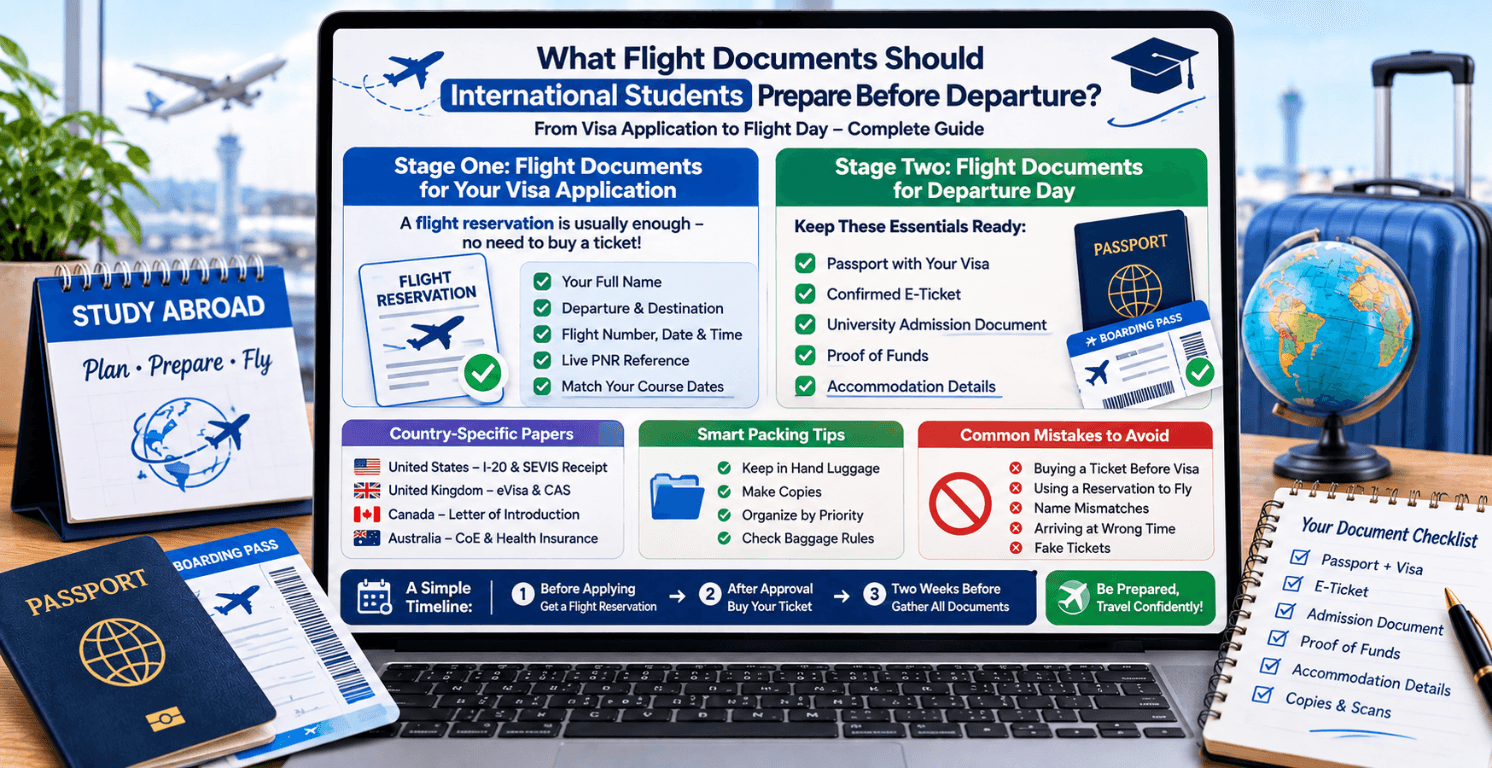
Stage One: Flight Documents for Your Visa Application
When you apply, the embassy wants to see that you have a plan to travel. It doesn't need you to have paid for it. Many student visa checklists ask for a flight reservation or a travel itinerary, and some countries don't ask for one at all.
Buying a ticket at this stage is risky. Student visas can take weeks, sometimes longer in peak intake season. If your visa is delayed or refused, or your university moves your start date, you're stuck with a ticket you can't use.
What a Student Visa Flight Reservation Should Show
A student visa flight reservation is a genuine booking held in the airline's system, in your name, without the fare being paid. A good one shows:
- Your full name, exactly as it appears in your passport
- Your departure city and destination airport
- Flight number, date, and time
- A live PNR (booking reference) that can be checked on the airline's website
Plan your dates around your course start. Most students book an arrival a week or two before orientation. That gives you time to settle in, and it shows the officer your plans line up with your offer letter.
You can see how this works on our student visa tickets page.
Match It to Your Admission Papers
Your travel dates should make sense next to your university documents. If your CAS, I-20 or letter of acceptance says classes start on 15 September, a flight landing on 3 October raises an obvious question. Keep your arrival before your start date, and leave a few days for jet lag, opening a bank account and finding your way around campus.
Should It Be One Way or Return?
Students on multi-year courses often aren't sure. It depends on your destination's checklist. Some embassies accept a one-way booking for long-term study, while others prefer a return. Check your embassy's list before you book. If it isn't clear, a return reservation is the safer choice.
Stage Two: Flight Documents for Departure Day
Your visa is approved. Now the reservation has done its job, and it's time to buy your real ticket. This is where the second set of flight documents for international students comes in.
The Essentials Every Student Needs
- Passport with your visa. Check that your passport is valid well beyond your arrival date. Some countries now issue digital visas, so make sure you can show yours.
- Confirmed e-ticket. Your paid ticket with a ticket number, not just the reservation from your visa stage.
- Admission document. Your university's official letter or form, such as a CAS for the UK, an I-20 for the US or a letter of acceptance for Canada.
- Proof of funds. Recent bank statements or a scholarship letter. Border officers can ask for them.
- Accommodation details. Your hostel or flat address and contact number.
Country-Specific Papers
Each destination has its own extras. A few common ones:
- United States. Carry your signed I-20 and your SEVIS fee payment receipt. F-1 students generally can't enter more than 30 days before their programme start date, so time your flight carefully.
- United Kingdom. The UK has moved to eVisas, so make sure you can access and share your immigration status online. Keep your CAS number handy.
- Canada. Carry the letter of introduction from IRCC. The officer at the port of entry uses it to issue your study permit.
- Australia. Keep your Confirmation of Enrolment and your health insurance details with you.
Rules change, so check your embassy's and university's latest guidance a few weeks before you fly.
Packing Your Documents the Smart Way
You've collected everything. Now make sure you can actually find it at 4 a.m. in a busy terminal.
Keep Them in Your Hand Luggage
Never pack your passport, admission letter or visa papers in checked baggage. If your suitcase is delayed, you'll still need them at immigration.
Make Copies
Keep printed copies in a separate pocket, and save scanned copies to your email or cloud storage. If something is lost, a copy makes replacing it much easier.
Order Them by When You'll Need Them
Put your e-ticket and passport on top for check-in. Then your visa and admission document for immigration. Then funds and accommodation details in case the officer asks more questions.
Check Your Baggage Allowance
Students tend to overpack. Check your airline's baggage rules before you go. Some airlines offer extra allowance for students, but you usually need to ask for it when booking.
Mistakes Students Make With Flight Documents
- Buying a ticket before the visa. If the visa is delayed, you may lose money changing or cancelling it.
- Using the visa-stage reservation to fly. A reservation isn't a ticket. You can't board with it.
- Name mismatches. Your ticket, passport and admission letter should spell your name the same way.
- Arriving too early or too late. Some countries limit how early students can enter. Others expect you before orientation.
- Fake tickets. Never submit an edited ticket with a made-up booking code. It can put your whole visa at risk. See what a genuine reservation looks like on our samples page.
A Simple Timeline
- Before applying: get a student visa flight reservation that matches your course start.
- After approval: buy your real ticket and check country-specific entry rules.
- Two weeks before departure: gather all documents, print copies and save scans.
- The night before: put everything in your hand luggage, in the order you'll need it.
For more on preparing your visa file, browse the DummysFlight blog or visit our flight reservation for visa page.
Planning your student visa application?
Get a verifiable flight reservation with a live PNR for your visa file.
Get Your Flight ReservationQuick Questions, Quick Answers
What flight documents for international students are needed at the visa stage?
Usually just a flight reservation that shows your route, dates, and a live PNR. Some countries don't ask for one at all. Check your embassy's checklist.
Do I need a paid ticket for a student visa?
Most embassies do not require one. A reservation shows your plan without risking the full fare if your visa is delayed or refused.
Can I fly using my visa reservation?
No. It's a booking for your visa file only. Buy your actual ticket once your visa is approved.
What should I carry in my hand luggage?
Your passport, visa, e-ticket, admission document, proof of funds, and accommodation details, plus copies of each.