
Two PDFs can look almost identical. Same airline logo. Same route. Same dates. Your name in capital letters at the top. One cost the full fare. The other cost almost nothing.
A visa officer can tell them apart in about four seconds. By the end of this page, you will too.
Most articles on flight reservation vs flight ticket stop at "one is paid, one isn't." That's true. But it won't help much when you're staring at a booking at 2am, the night before your embassy appointment, trying to work out what you actually have. So we'll do this differently. We'll open the document up and look at its parts, one by one.
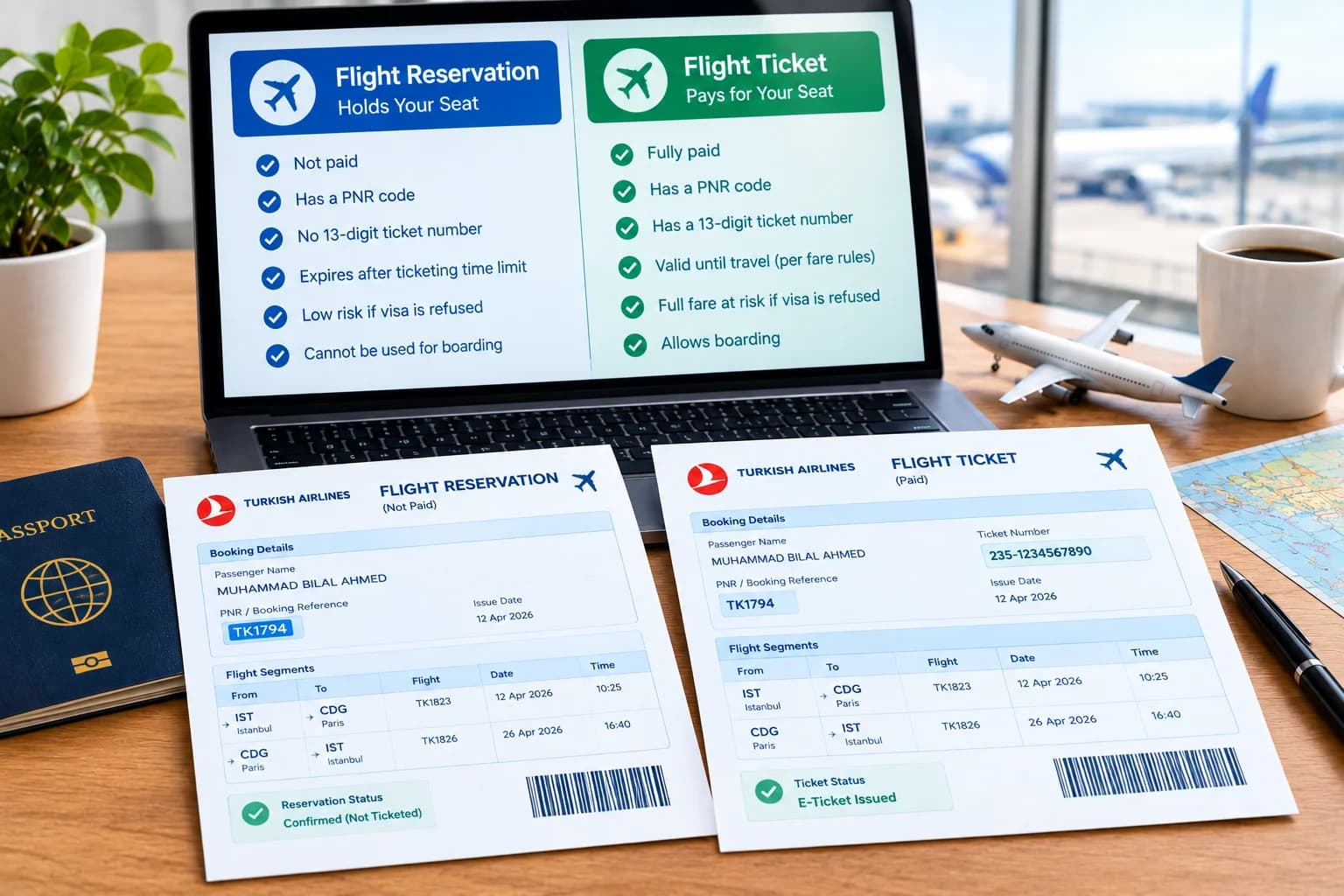
A flight reservation holds your seat; a flight ticket pays for it. Know which one you hold before your visa interview.
Start With the Six Characters Every Booking Has
Every airline booking, paid or unpaid, gets a PNR. That stands for Passenger Name Record. It's a six-character code mixing letters and numbers, something like K7XQ2M. Airlines and agents use it to pull up your booking in their system.
Here's what catches people out. Both a reservation and a ticket have a PNR. So if someone says "it has a PNR, so it's a confirmed ticket," they're mistaken. A PNR proves a seat is being held in your name. It says nothing about whether anyone has paid for it.
Now Look for the 13-Digit Number
This is the test that settles it. A paid ticket carries an e-ticket number. It's 13 digits long, and the first three digits identify the airline:
- Emirates tickets start with 176
- Qatar Airways uses 157
- PIA uses 214
A reservation has no e-ticket number at all. There's nothing to issue yet, because no payment has gone through.
So if you want the simplest difference between flight reservation and ticket, here it is. A PNR on its own means reserved. A PNR plus a 13-digit ticket number means ticketed. Check your document for that number and you'll know in seconds.
Check the Clock on the Booking
A ticket stays valid until you fly, change it, or cancel it, based on the fare rules you bought under.
A reservation works on a deadline. Airlines call it the ticketing time limit. Some hold a seat for a day. Others hold it for a week or two. It depends on the airline, the fare class, and how far away the departure date is. When the limit passes and nobody pays, the seat goes back on sale and the PNR stops working.
This detail matters more than people think. If your visa appointment is ten days away and your reservation expires in three, you'll be handing the embassy a booking that no longer exists. With reservations, timing is half the job.
Side by Side Comparison
| Flight Reservation | Flight Ticket |
|---|---|
| Payment: not paid | Payment: fully paid |
| PNR code: yes | PNR code: yes |
| 13-digit e-ticket number: no | 13-digit e-ticket number: yes |
| How long it lasts: until the ticketing time limit | How long it lasts: until travel, per fare rules |
| Money at risk if visa is refused: very little | Money at risk if visa is refused: can be the full fare |
| Lets you board the plane: no | Lets you board the plane: yes |
| Best used for: visa applications and travel planning | Best used for: actually flying |
Why Embassies Usually Want the Reservation, Not the Ticket
Many consulates, including most Schengen countries, advise applicants not to buy a full ticket before the visa is approved. That advice protects you. Refusals happen, and when they do, a non-refundable fare is money you won't see again.
What the embassy wants is a clear travel plan:
- A route
- Dates that match your leave letter and hotel booking
- A return or onward flight that shows you plan to leave on time
A verifiable reservation shows all of that.
Here's where the difference between flight reservation and ticket turns into money saved. Say you're flying Lahore to Paris for two weeks in July. A summer return fare can easily run into six figures. If the visa is refused and the fare is non-refundable, you're stuck chasing a refund you probably won't get. A reservation gives the embassy the same route and the same dates for a small fraction of that cost.
One honest note. A few embassies ask for a paid ticket, usually at a later stage or for certain visa types. Always read the checklist from the embassy or visa center you're applying through. It overrides any general advice, including ours.
When You Do Need the Paid Ticket
You need a ticket to board. No airline will check you in on a reservation. Some countries also check for proof of return or onward travel at the check-in desk, and a lapsed reservation won't pass there.
The smart order is simple:
- Reserve first
- Apply for the visa
- Buy the ticket once your passport comes back stamped
You keep your money safe until you know the trip is actually happening.
Five Checks Before You Submit Your Visa File
- Your name matches your passport exactly, including middle names and spelling.
- Travel dates match your cover letter, leave letter, and hotel booking.
- The PNR opens on the airline's Manage Booking page.
- The reservation is still valid on your appointment date, not just the day you print it.
- A return or onward flight is included, not just the outbound leg.
Miss one of these and a solid application can start looking shaky. Tick all five and your flight proof won't be the reason anything goes wrong.
How We Handle It at DummysFlight
We issue verifiable flight reservations built around visa files, not around airline sales. Each one comes with a working PNR you can check on the airline's own site, and we set the validity with your appointment date in mind. See our dummy ticket services for the full range.
If you're applying for a holiday or family visit, our tourist visa tickets cover round trips that line up with your itinerary. Students heading abroad for university can use our student visa tickets, which fit the longer gap between arrival and return. Need accommodation proof as well? Pair your flight with a hotel reservation for visa so both documents show the same dates.
The Bottom Line
The flight reservation vs flight ticket question isn't about which one is better. It's about what the document needs to do right now. For the embassy, you need proof of a plan. For the airport, you need proof of payment.
Once you know the difference between flight reservation and ticket, the rest comes down to timing. Reserve smart, apply with confidence, and buy the ticket when the visa is in your hand.
Frequently Asked Questions
- Can I verify a flight reservation on the airline's website?
- Yes. A proper reservation has a working PNR. Enter it with your surname on the airline's Manage Booking page and your booking details should appear.
- Is a flight reservation the same as a dummy ticket?
- Mostly, yes. "Dummy ticket" is a common name for a verifiable reservation used for visa applications. It holds a seat but isn't paid, so it can't be used to fly.
- How long does a flight reservation stay valid?
- It depends on the airline and fare. Some hold for 24 hours, others for two weeks. Always make sure yours is valid on your appointment date.
- Will an embassy reject my visa for using a reservation?
- Most embassies accept, and even prefer, reservations for visa files. A few ask for paid tickets in specific cases, so check your embassy's official document checklist first.
- Can I board a flight with just a PNR?
- No. Boarding needs an issued e-ticket with a 13-digit ticket number. A PNR alone only shows a seat is being held in your name.
Get Your Verifiable Flight Reservation
Get a professional flight reservation with a working PNR you can verify on the airline's website.
Get Your Flight Reservation Now