
Airlines, travel agents, and embassy checklists all use the word itinerary, and they do not always mean quite the same thing. For one, it is the plan of your journey. For another, it is a specific PDF with specific fields on it. For a visa officer, it is a document that has to answer a short list of questions in about twenty seconds. If you are booking travel or preparing a flight reservation for a visa, knowing which version you are holding saves a lot of confusion later. This guide covers what a flight itinerary is, every field it should carry, how it differs from a ticket, and when a provisional itinerary is the right document to submit.
A flight itinerary is a document that sets out your planned journey: passenger name, airline, flight numbers, departure and arrival airports, dates and times, and a booking reference. It describes the trip. It is not proof of payment, and it is not the pass that gets you through the gate.
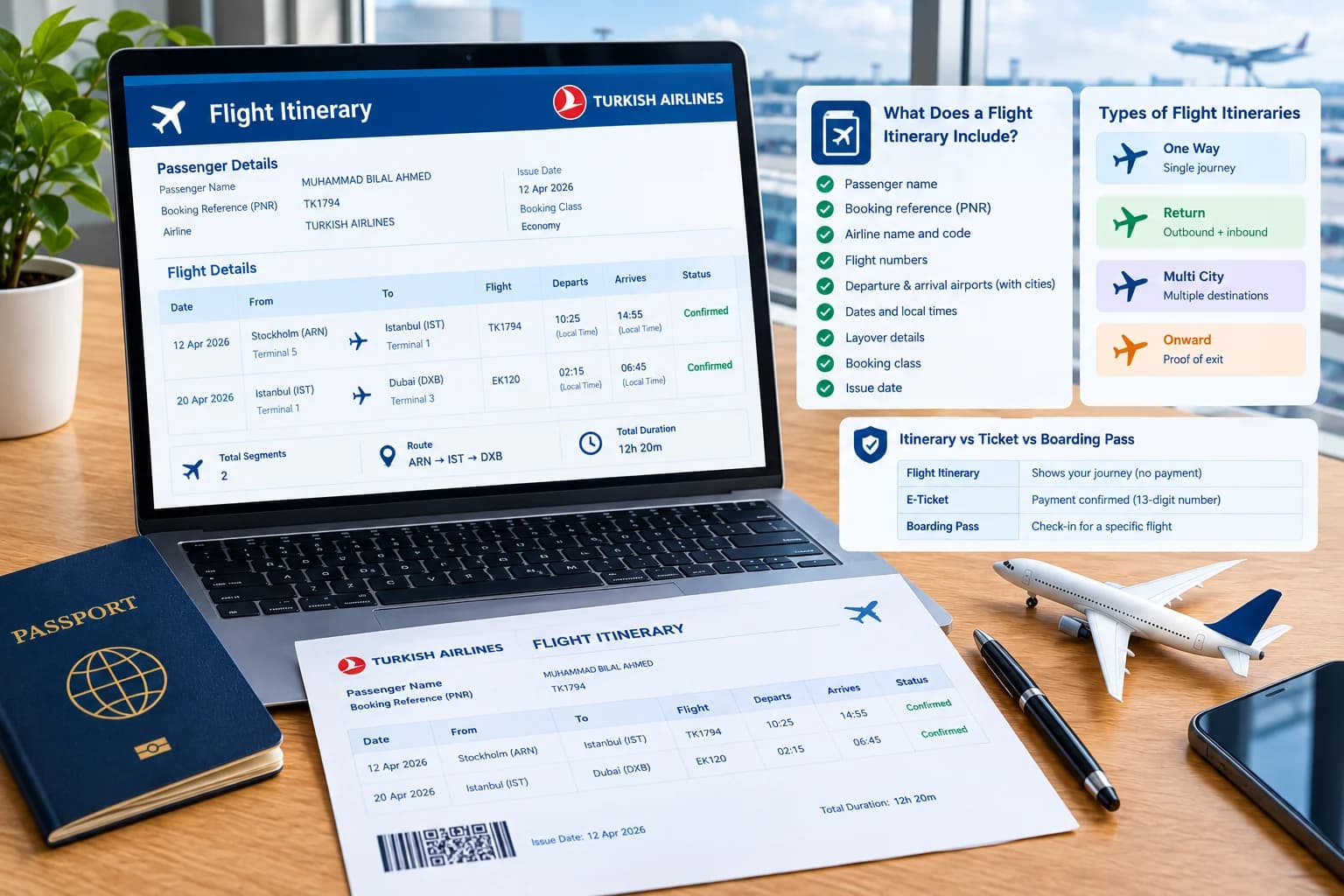
A flight itinerary describes your reserved journey with all the key details visa officers need to verify.
What Is the Itinerary for a Flight?
At its simplest, it is your journey written down in the airline's own format. Every segment you are scheduled to fly, in order, with the times attached.
The document is generated the moment a booking is created, so it exists before any money changes hands. That is worth understanding, because it explains why an itinerary can be issued for a reservation that has not been ticketed. The airline has held the seats and produced a description of the trip. Payment converts that reservation into a ticket, but it does not change what the itinerary says.
You will see the same document called a travel itinerary, a flight reservation, an itinerary receipt or a booking confirmation depending on who issued it.
What Information Does a Flight Itinerary Include?
| Field | What it tells you |
|---|---|
| Passenger name | Who the reservation is held for, as printed in the passport |
| Booking reference or PNR | The code that retrieves the record from the airline system |
| Airline name and code | Which carrier operates each segment |
| Flight number | The specific scheduled service |
| Departure airport, city and terminal | Where the journey starts |
| Arrival airport and city | Where it ends |
| Date and local time of each segment | When you fly, in local time at each end |
| Layover details | Connection airports and waiting time |
| Booking class | The fare category, which sets change and baggage rules |
| Issue date | When the document was generated |
Two habits save trouble. Read every time as local time, because a long haul itinerary showing a next day arrival is normal and not an error. And check the passenger name character by character against the passport, since that field causes more problems than any other on the list.
Flight Itinerary vs Ticket vs Boarding Pass
| Document | What it proves | When you get it |
|---|---|---|
| Flight itinerary | The journey that has been reserved | At booking, paid or not |
| Electronic ticket | The fare has been paid and issued | After payment |
| Boarding pass | You are checked in for a specific flight and seat | Within hours of departure |
People use these interchangeably and then run into trouble on a form. If an embassy asks for an itinerary, it wants the first document. If an airline asks for a ticket number, only the second one carries it. The boarding pass is a departure day item and never belongs in a visa file.
Types of Flight Itinerary
One way. A single journey with no return segment. Used for relocations, open-ended travel, and as proof of exit at immigration counters, which we cover in our guide on what an onward ticket is.
Return. Outbound and inbound on one record, ending where you started. The standard shape for tourist trips and the format most visa checklists expect. A return itinerary covers this.
Multi city. Several destinations on one continuous record. Right for a trip through more than one country, and cleaner in a visa file than three unrelated bookings. Use a multi-city itinerary for these.
Onward. A one-way booking out of the country you are entering, to anywhere. Airlines and border officers ask for it when your entry permission depends on you leaving again.
What Is a Dummy Flight Itinerary for a Visa Application?
It is the same document, issued against a reservation that has not been paid for. Real airline, real flight numbers, real booking reference, no fare settled.
Consulates ask for it precisely because it is unpaid. Buying a confirmed ticket before a decision puts the full airfare at risk, and most missions openly advise against it. What the officer needs is your intended plan: where you are going, when you arrive, when you leave, and whether that fits the visa you asked for.
The fields an officer checks are slightly narrower than the full itinerary list above, and the standards are stricter on names and dates. Our breakdown of visa flight itinerary requirements walks through each one, and you can see a correctly formatted example on our samples page.
Key Takeaways
A flight itinerary describes a journey that has been reserved. It carries the passenger name, the airline and flight numbers, the full route with dates and times, and the code that retrieves the booking. Payment is a separate step, which is why an itinerary works as visa evidence without you buying anything. Match the type to the trip, check the name against the passport, and make sure the reservation behind it is still live when you submit.
Need one for an application? Create your flight itinerary here, or browse more travel document guides on our blog.
Frequently Asked Questions
- What is the itinerary for a flight?
- It is the document setting out your reserved journey: passenger name, airline, flight numbers, departure and arrival airports, dates, times and a booking reference. It describes the trip rather than proving payment for it.
- What information does a flight itinerary include?
- Passenger name, booking reference or PNR, airline and flight numbers, departure and arrival airports with cities, dates and local times for each segment, layover details, booking class and the issue date of the document.
- Is a flight itinerary the same as a ticket?
- No. An itinerary describes the reserved journey and exists from the moment of booking. A ticket carries a thirteen-digit number and only exists once the fare has been paid and issued.
- What is a dummy flight itinerary for a visa application?
- It is a genuine itinerary issued against an unpaid provisional reservation. It shows real flight data for your intended trip, which is what consular checklists ask for, without committing the full airfare before a decision.
- Do I need a return itinerary or a one-way one?
- Tourist and Schengen applications almost always require a return itinerary as proof of return. One-way itineraries suit relocations, open-ended travel, and proof of onward exit at immigration counters.
Need a Flight Itinerary for Your Visa?
Get a professional flight reservation with all the fields visa officers need to verify your travel plans.
Get Your Flight Itinerary Now